
Ask a golfer how far they hit their 7-iron and you will get a confident answer. Ask how far they hit a three-quarter pitching wedge and you will get a shrug, a hand gesture, and the word "depends." That is not a character flaw. Wedges are the clubs we use from the widest range of distances, with the most variation in swing length, so they are the hardest clubs to know by heart.
They are also where a lot of strokes hide. Most of us hit a green in regulation less often than we would like, which means the next shot is a wedge, a pitch or a chip from somewhere inside 100 yards. Getting those shots to land closer, more often, is one of the most reliable ways to shave a few strokes without changing a thing about your full swing. Here is a simple plan for building real wedge numbers on a golf simulator, with no gimmicks and nothing that asks you to be a different golfer.
Why wedge distance is its own skill
With a driver or a mid-iron, you mostly swing one way and let the club do the work. Wedges ask for a different job: hitting the same club to several different distances. That means controlling how long your backswing goes, how fast you accelerate, and how the club loft and strike combine at the bottom. Small changes add up quickly. A few feet of extra backswing, or a slightly thin strike, can move the ball ten yards without you noticing.
That is exactly why feel alone is a shaky guide. On the course you get one shot at each distance, with different lies, a different breeze and a different mood. In a bay you can hit twenty balls in a row with the same intention and see exactly what your body is doing. The screen shows the carry distance, which is the number that actually matters for wedges, since you are trying to land the ball on a spot, not roll it to one.
What to look at on the screen
You do not need to track everything. For wedge work, three numbers do most of the job. If any of them are new to you, our beginner's guide to golf simulator data explains each in plain language.
- Carry distance. How far the ball flies before it lands. This is your yardage. Ignore total distance for wedges, because the surface at the other end changes the roll.
- Ball speed. A quick way to see whether two swings that felt different really were different. When your three-quarter shots all show similar ball speed, your tempo is doing its job.
- Launch and spin. Useful as a check, not a target. If a shot flies much lower or higher than usual, that tells you something about strike or loft that carry alone will not.
Keep it to carry first. Once that is steady, the other numbers are bonus information rather than homework.
Step one: choose your clock-face swings
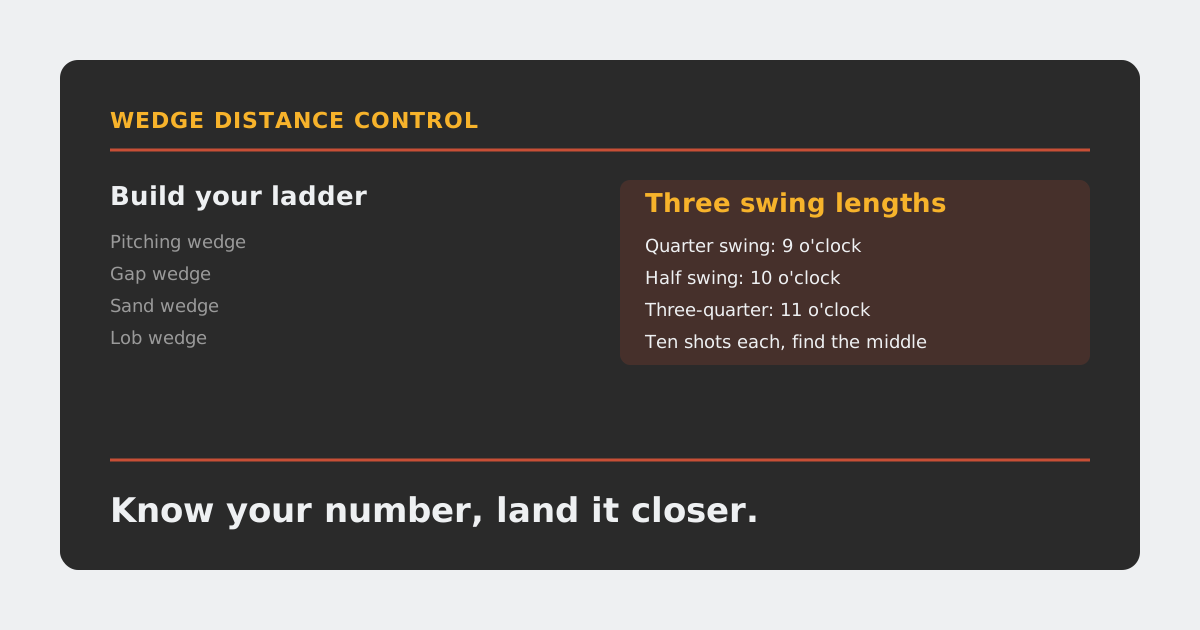
The simplest wedge system is one most teachers recommend in some form: pick a small number of repeatable swing lengths, then learn the distance of each. A common way to describe them is the clock face, imagining your lead arm pointing to a time on a clock at the top of the backswing.
- Quarter swing: your lead arm back to roughly 9 o'clock. A short, controlled shot.
- Half swing: a bit longer, with the arm around 10 o'clock.
- Three-quarter swing: nearly full, the arm around 11 o'clock.
You do not need to hit those positions perfectly. What matters is that you can repeat the same length again and again, and that you swing at a steady tempo rather than speeding up on short shots. Decelerating into the ball is the most common wedge mistake, and it is easy to spot on a screen because your numbers will jump around.
Step two: build the ladder
Now put numbers on it. Grab the wedges you actually carry. Most golfers have between two and four, such as a pitching wedge, a gap wedge, a sand wedge and a lob wedge. If you only have one or two, this works just as well.
Warm up first
Hit eight to ten easy shots with a wedge you like. You are not collecting data yet, just settling into a rhythm.
Hit ten shots at each length
For each wedge, hit ten balls with a quarter swing, then ten with a half swing, then ten with a three-quarter swing. Do not chase a number. Make the same move each time and let the screen tell you what it produced. If a shot is a clear miss, such as a mishit or a topped ball, mark it and set it aside.
Find the middle, not the best
For each group, ignore the best and worst shots and write down the typical carry. That is your number. It is also useful to note the spread: if your half-swing sand wedge carries between 62 and 68 yards, you have a six-yard window. That window is something you can shrink over time, and it is honest information about how well you can aim at a flag.
Write it down
A one-page card in your bag or a note on your phone is enough. Something like this, with your own numbers:
- Pitching wedge: quarter, half, three-quarter
- Gap wedge: quarter, half, three-quarter
- Sand wedge: quarter, half, three-quarter
- Lob wedge: quarter, half, three-quarter
Looking at that grid for the first time is often a small revelation. You will usually find big gaps in your coverage and some clubs that overlap, such as a three-quarter lob wedge that lands at the same spot as a half sand wedge. Knowing that is half the battle. If you have not yet built the longer end of your chart, start with our guide to building a yardage chart on a simulator and bring the wedge ladder in as the final piece.
If you would like a second set of eyes while you build it, our team is happy to help you read the screen. Book a bay online and bring the wedges you actually play.
Step three: practice it with a target game
Numbers on a card are a starting point. The real skill is picking the right one and executing it under a little pressure. Here is a simple game that does both.
The yardage lottery
Have a friend (or a random number on your phone) call out a distance between 30 and 100 yards. You have to pick the club and swing length from your ladder, hit one ball, and check where it carried. Score yourself like this:
- Within three yards: 3 points
- Within six yards: 1 point
- Anything else: 0
Play ten rounds and note your total. Come back the following week and try to beat it. Because the distance is unpredictable, you cannot get into a rhythm of repeating the same shot, which is exactly what makes it feel like the course. It is also a pleasantly competitive way to spend an evening with a playing partner, and there is canned beer and wine in the lounge during staffed hours if the loser is buying.
The ladder drill
For a quieter session, hit one ball each at 30, 40, 50, 60, 70 and 80 yards, in order, then work back down. Each shot is a new decision, and the screen shows you immediately if you chose the wrong swing length. Over time you will notice the same mistake repeating, usually either too much speed on short shots or too little on long ones, and that is the thing to fix.
Common wedge problems the numbers will reveal
Your short shots go too far
This usually comes from swinging the club back a small distance but still accelerating hard through impact. Slow your tempo down and focus on matching the length of your backswing and your follow-through. On the screen, you should see ball speed drop as the swing gets shorter.
Your carry numbers are all over the place
A wide spread on a single swing length is usually a strike problem rather than a distance problem. Pay attention to where on the face you are making contact. If the shots that fall short are also the ones that fly lower, you are likely catching the ball a little thin.
The gaps are uneven
If two wedges land within a couple of yards of each other and then there is a twenty-yard hole before the next one, you can adjust: change which swing length you use with each club, or ask a fitter or teacher about loft spacing the next time you shop. Many players are surprised how much of a difference a few degrees of loft makes.
Take it back to the course
The goal is to leave with a card you trust, not a perfect simulator score. We love outdoor golf, and everything here is meant to make your time on the course more enjoyable. A simulator is wonderful for learning your numbers, but the course is where you use them: different lies, wind and nerves all matter. Take your yardage card out on a practice round, check it against what actually happens, and adjust. If you play at Gleannloch Pines or any of the other courses around Spring and Klein, you will probably find that your numbers hold up better than you expected, with a few small corrections for the greens you know best.
If you want to fold this into a bigger plan, our 60-minute golf simulator practice plan shows where a wedge block fits into a full session, and our winter practice guide covers how to spread this work across the off-season.
Common questions about wedge distance control
How many wedges should I carry?
There is no single right answer. Many golfers carry three or four, such as a pitching wedge, a gap wedge, a sand wedge and a lob wedge, but what matters most is knowing the distances for the ones you have. If you are not sure whether your set has gaps, building the ladder will show you.
Do I need to hit full shots with every wedge?
No. Many of your most useful scoring shots are partial swings. The ladder includes a three-quarter swing for that reason, and you can add a full swing too if you like.
How accurate are simulator wedge numbers?
Modern launch monitors measure carry well on partial shots, and our Uneekor XO2 bays are no exception, though no system is perfect. Treat the numbers as a very good guide, then confirm them on the course with a few real shots. We go deeper on this in our article on how accurate golf simulators are.
How often should I practice wedges?
Once a week for twenty or thirty minutes goes a long way. You can tack a wedge block onto another session or make it the whole reason for a short visit.
What does a session cost?
Open bays start at $25 an hour Monday to Thursday off-peak, and private bays start at $35. Rates are per bay, not per person. Current rates are on our play and pricing page, and if you plan to practice often, our memberships are worth a look.
Start with one wedge
You do not have to build the whole ladder in one evening. Pick your favorite wedge, find your quarter, half and three-quarter carries, and write them down. Then come back next week and add the next club. By the time the weather turns warm, you will have a card that turns a vague "about 70" into a number you can commit to. We are at 19059 Champion Forest Drive in Spring, with six Uneekor XO2 bays open around the clock for verified guests. Book a bay, bring your wedges, and let's get you closer to the pin. Building community through golf, one scoring shot at a time.