
The first time a golfer steps into a bay at Birdie Central, hits a 7 iron, and turns to the screen, the reaction is almost always the same. There are a dozen numbers up there, and no obvious clue about which one matters. Ball speed. Club path. Attack angle. Smash factor. It reads like a spreadsheet wearing golf shoes.
Here is the good news. You do not need all of it, you never did, and the golfers who improve fastest on a simulator are usually the ones paying close attention to two or three numbers rather than glancing at twenty. This guide is written for the golfer who has never looked at simulator data before, or who has looked at it and quietly decided it was for somebody else. We will explain what each number is actually telling you, in plain English, and give you a sensible order to learn them in.
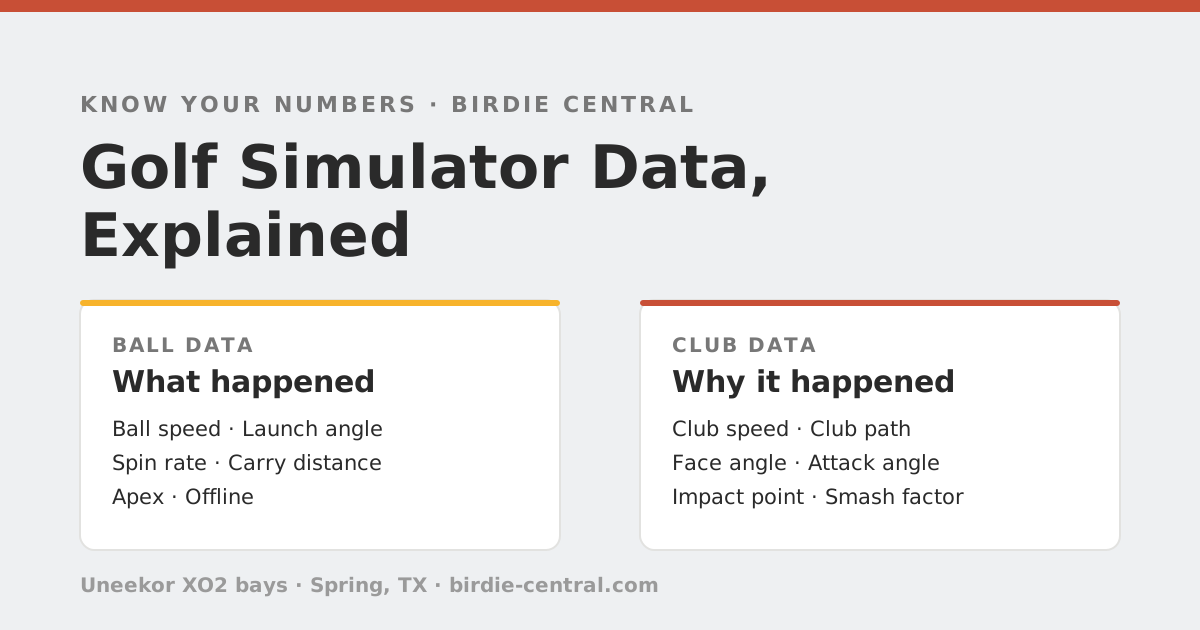
Start here: ball data tells you what, club data tells you why
Every number on the screen belongs to one of two families, and once you can sort them, the whole display gets a lot less intimidating.
Ball data describes what the golf ball did after it left the face. Ball speed, launch angle, spin rate, carry distance, apex height, and how far offline it finished. This is the outcome. It is the part you could roughly see with your own eyes on a driving range, except measured instead of estimated.
Club data describes how you delivered the clubhead into the ball. Club speed, club path, face angle, angle of attack, and where on the face you made contact. This is the cause. It is also the part you genuinely cannot see, no matter how long you have been playing, which is exactly why a simulator is worth the hour.
Our bays run Uneekor XO2 overhead systems, which read a standard golf ball with no stickers or markings required and capture club delivery through the impact zone at the same time. So you get both families on the same shot. If you want the deeper walk through the ball side of the ledger, we covered it separately in understanding your launch monitor numbers. This article leans on the club side, because that is where most golfers find the answer they were actually looking for.
The club numbers worth knowing
Club speed
How fast the clubhead is travelling at impact, in miles per hour. It is the raw ingredient of distance, and it is also the number golfers most enjoy chasing. Chase it carefully. Speed only becomes distance if you strike the ball well, and a golfer who swings 5 mph slower but finds the middle of the face will usually hit it past the one who does not.
Smash factor
Ball speed divided by club speed. It is a one number report card on how solidly you struck it. With a driver, roughly 1.5 is the practical ceiling and anything near it means you found the center. With a 7 iron, the mid to high 1.3s is a healthy range because irons have more loft and lose a little efficiency by design. If your smash factor is well below those numbers, the fix is contact, not effort.
Angle of attack
Whether the clubhead is moving downward or upward at the moment it meets the ball, measured in degrees. Negative means descending, positive means ascending.
This one confuses newcomers more than any other, because the correct answer changes by club. With an iron off the turf you want a descending strike, ball first and turf second, so a negative number is not a flaw, it is the goal. With a driver off a tee, an ascending strike is generally the friendlier one, because hitting up launches the ball higher with less spin and that combination carries further. If you have ever been told to hit down on your irons and up on your driver, angle of attack is the number that finally shows you whether you are doing it.
Club path
The direction the clubhead is travelling through impact, relative to your target line. Negative typically means the club is moving to the left of target through the ball, often described as out to in. Positive means it is moving to the right, or in to out. Most solid ball strikers live within about two degrees either side of zero, though plenty of good players deliberately sit slightly on one side to favor a shape they trust.
Face angle
Where the clubface is aimed at impact, relative to the target line. Open points right for a right handed golfer, closed points left. Face angle is the single biggest influence on where your ball starts, so if your shots begin well right or well left of where you aimed, this is the number to look at first.
Face to path
The relationship between the two numbers above, and the reason your ball curves. When the face is pointed right of the path the ball curves right, when it is pointed left of the path it curves left, and when the two roughly agree the ball flies fairly straight.
This one deserves a moment, because it quietly solves the most common frustration in golf. A slice is not simply an open face, and it is not simply a path problem. It is the gap between them. Once you can see that gap on a screen, shot after shot, you stop guessing about your slice and start actually working on it.
Impact point
Where on the face you made contact, usually shown as a dot on a little clubface graphic. It is the least glamorous readout on the screen and one of the most useful. Heel strikes, toe strikes, and low face contact explain an enormous share of the shots that felt fine and went nowhere.
A sensible order to learn them in
You do not have to absorb all of that today. Here is the progression we walk new golfers through in the bays, and it works whether you are a first timer or a 20 handicapper who has been playing for years.
- Session one, learn your carry distances. Hit ten balls with each of four or five clubs and write down the average carry. Not the best one, the average. Most golfers discover they have been playing one club too little for years, and this alone will save you strokes at Gleannloch this weekend.
- Session two, add smash factor and impact point. These two together tell you how well you are striking the ball. Nothing else improves until this does.
- Session three, add face angle and club path. Now you can explain your shot shape instead of enduring it. Watch how a small change in setup or grip moves those numbers.
- Session four and beyond, add angle of attack. Tune your driver upward and your irons downward, and you will pick up distance you already owned.
Four focused hours spread over a few weeks will teach you more about your own swing than a full season of hitting balls without feedback. That is not a knock on the range or the golf course, both of which we love. It is just that a bay tells you the why, and the why is hard to find anywhere else.
Ready to see your own numbers? Book a bay at Birdie Central in Spring and bring the clubs you actually play.
How to use one session's worth of data
A practical habit that pays off: pick one number per session and leave the rest alone. Data becomes overwhelming the moment you try to fix four things at once, and it becomes genuinely useful the moment you narrow it down.
Take a photo of your session summary before you leave the bay, or jot the averages in your phone. Over four or five visits you will have a personal baseline, and a baseline is what turns a screen full of numbers into evidence that you are getting better. It also makes conversations with an instructor far more productive, because you arrive with facts instead of impressions.
One more thing worth saying plainly. Chase averages, not single shots. Everybody hits one beauty an hour. The number that predicts your scores is the middle of your bell curve, not the top of it.
What the numbers will not tell you
Simulator data is honest, but it is not the whole game. It will not read the wind at Gleannloch Pines, or tell you how a downhill lie changes your balance, or teach you the nerve it takes to hit a 6 iron over water when the round is on the line. Golf outdoors will always own those lessons, and it should.
What the data does is shorten the guessing. You walk to the first tee already knowing your carry numbers, already knowing which miss is likely today, and already having practiced the fix. That is a meaningfully better place to start a round from. If you are still weighing where your practice hour is best spent, we made the honest case for both in golf simulator vs driving range.
Frequently asked questions
Do I need to understand the data to enjoy a simulator session?
Not at all. Plenty of our guests book a bay to play Pebble Beach with friends and never glance at a number, and that is a perfectly good evening. The data is there when you want it and quietly out of the way when you do not.
How accurate are the numbers on a golf simulator?
On a quality, properly calibrated system, ball data is dependable within a few yards and club data is consistent enough to make real swing decisions from. We went into the detail in how accurate are golf simulators.
Which single number should a beginner watch?
Carry distance, by a comfortable margin. Knowing that your 8 iron carries 138 yards rather than the 150 you have been telling people is the fastest scoring improvement available to most golfers, and it requires no swing change whatsoever.
Can I bring my own clubs and use my normal ball?
Yes to both, and we would encourage it. The numbers only mean something if they came from the equipment you actually play. Our bays read a standard golf ball, so there is nothing special to buy.
Come read your own numbers
Simulator data is not a test you can fail. It is just your golf swing, described accurately, for probably the first time. Most golfers find the experience less like being graded and more like finally getting the manual for a machine they have been operating by feel for years.
We are at 19059 Champion Forest Drive in Spring, a couple of minutes from Gleannloch, with six bays, Uneekor XO2 tracking, beer and wine, and 24/7 access once you are set up. Come for an hour, hit forty balls, and leave knowing something true about your game. Book your bay, or take a look at our memberships if you think this is going to become a habit. Building community through golf, one honest number at a time.