
It is the question almost everyone asks before their first visit, usually with one eyebrow slightly raised. You hit a ball into a screen a few feet away, and a computer tells you it flew 268 yards with 2,400 rpm of backspin. Sounds a little too tidy, right? So let us answer it plainly and without the sales pitch: how accurate are golf simulators, really?
The honest, useful answer is that a well-built, properly calibrated simulator is far more accurate than most golfers expect, accurate enough that PGA Tour players, club fitters, and college teams rely on the same technology to make real decisions about their equipment and their swings. It is not magic, and it is not guessing. It is measurement. The trick is understanding what the machine is actually reading and what makes one setup more trustworthy than another.
The short answer, before we get into the how
A quality golf simulator measures your shot to within a few yards of carry distance and reads spin, launch, and clubface data with the kind of precision that used to require a tour van. The numbers you see are not a simulation of what your swing might do. They are a measurement of what your swing just did, translated into a ball flight on the screen.
Where accuracy varies is in the equipment and the room around it. A launch monitor from a serious manufacturer, mounted correctly, calibrated, and paired with a proper hitting surface, is a genuinely precise instrument. A cheap sensor sitting on the floor of a cramped garage is a different story. So the real question is not "are simulators accurate," it is "is this simulator accurate," and that comes down to a few specific things we will walk through.
How a simulator actually measures your shot
Every simulator lives or dies on its launch monitor, the sensor that watches your ball and club at the moment of impact. There are two main ways it does that, and knowing the difference tells you a lot about what to trust.
Camera-based systems (photometric)
Photometric monitors use high-speed cameras to photograph the ball and clubface in the fractions of a second around impact. From those images the system reads ball speed, launch angle, spin, club path, face angle, and more, then calculates the resulting flight. Because cameras capture what happens right at the strike rather than tracking the ball through the air, they work beautifully indoors where the ball only travels a few feet before hitting the screen.
Radar-based systems (Doppler)
Radar monitors bounce a signal off the ball and track its movement through the air, which makes them excellent at reading full ball flight and total distance. The tradeoff is that radar likes to see the ball travel, so it generally wants more room behind and in front of the hitter to gather a complete picture. That is why radar is a natural fit on an outdoor range and why camera systems have become the standard for tight indoor bays.
Neither approach is "better" in the abstract. They are built for different environments. Indoors, where the ball meets a screen almost immediately, a high quality camera system captures the data cleanly and consistently, which is exactly why it is the technology of choice at most serious indoor venues.
What we use at Birdie Central, and why it matters
Our bays run on Uneekor EYE XO2 launch monitors, which are overhead, ceiling-mounted camera systems. A few details are worth knowing, because they are the difference between "close enough" and genuinely precise.
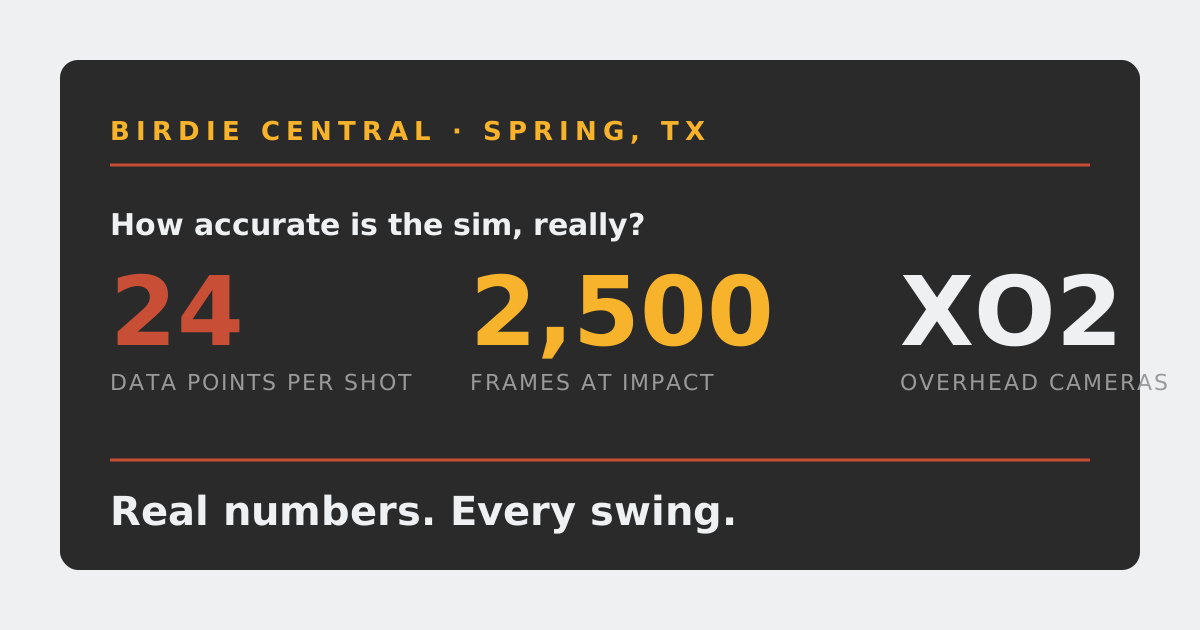
The XO2 reads 24 separate data points on every shot, covering both ball metrics like ball speed, spin, and launch angle and club metrics like club path, face angle, dynamic loft, and where on the face you made contact. It captures 2,500 frames at the moment of impact, which is an enormous amount of information about a strike that lasts less than a thousandth of a second. And thanks to its dimple-reading technology, it pulls accurate spin numbers off a normal golf ball, so you can play the same ball you trust rather than a special marked one.
Mounting the cameras overhead matters too. It keeps the sensor out of your swing path and reads the ball from a clean angle, which helps the system stay consistent shot after shot. Combine that hardware with a calibrated setup and a proper hitting surface, and the readout on the screen becomes something you can actually build a practice session around.
Curious what your real numbers look like? The fastest way to answer the accuracy question is to hit a few shots and see for yourself. Book a bay at Birdie Central in Spring and watch your own ball flight come back in full detail.
The things that actually affect accuracy
If two simulators can give different results, it is usually because of the environment around the launch monitor, not the concept itself. Four factors do most of the work.
Calibration. A launch monitor that has been set up and calibrated correctly delivers reliable club data. One that has been bumped, tilted, or never properly aligned will drift. This is the single biggest reason a professional venue tends to read more consistently than a hastily assembled home rig.
The hitting surface. Mats that do not flex like real turf can nudge your spin readings, especially on wedges and irons. A quality surface that lets the club interact with the ground more naturally keeps those numbers honest.
The golf ball. Some systems are picky about the ball, or need a specific marking to read spin. Dimple-reading cameras like the XO2 sidestep that by reading a standard ball directly, which removes one more variable.
The room. Enough space to make a full, uninhibited swing, plus proper lighting for camera systems, lets the sensor do its job. A bay built for golf, with the height and depth a real swing needs, is doing quiet work for your accuracy before you ever hit a shot.
Where the sim shines, and where the course still wins
Here is the part we will always be straight with you about, because we love outdoor golf just as much as indoor. A simulator is an extraordinary tool for measuring and improving your swing. It gives you instant, objective feedback on every shot, it never rains, and it lets you work on the exact same 7-iron carry a hundred times in a row without walking to pick up a single ball. For building a repeatable swing and understanding your own game, it is honestly hard to beat.
What a screen cannot fully replicate is the feel of a real course: the roll of a firm fairway, the read of a breaking putt on live grass, the wind, the nerves on the first tee. That is not a knock on the technology, it is just a different experience. The best way to think about it is that the sim keeps your swing sharp and your data honest so that your next round at a course like Gleannloch Pines feels like time well spent rather than a reset. Practice indoors, play outdoors, and let each one make the other better.
If you want to go deeper on what all those readings mean, our guide to understanding your launch monitor numbers breaks down ball speed, smash factor, and spin in plain English. And if this would be your first time in a bay, what to expect at an indoor golf simulator in Spring covers how a visit actually works — and the quick practical checklist is on our First Visit guide.
Frequently asked questions
How accurate are golf simulators compared to real ball flight?
A quality, properly calibrated simulator reads carry distance to within a few yards of real ball flight and measures spin, launch, and clubface data with tour-level precision. The numbers reflect what your swing actually did at impact, which is why fitters and coaches trust them for real decisions.
Are camera-based simulators accurate indoors?
Yes, and they are arguably the best fit for indoor play. Camera (photometric) systems read the ball and club right at impact rather than tracking full flight, so they capture clean, consistent data in the short space of an indoor bay. Our Uneekor XO2 units are overhead camera systems built exactly for this.
Do I need a special golf ball for the numbers to be accurate?
Not with our setup. The Uneekor XO2 reads the dimple pattern of a standard golf ball to measure spin, so you can play the same ball you would use on the course and still get accurate readings. No stickers or marked balls required.
What makes one simulator more accurate than another?
Mostly the environment around the sensor: proper calibration, a quality hitting surface that behaves like turf, good lighting and space for camera systems, and a launch monitor from a serious manufacturer. A well-built venue controls all of these, which is why it reads more consistently than a budget home setup.
See it for yourself in Spring
The most convincing accuracy test is the one you run with your own swing. Come hit a few shots, watch the ball flight on the screen match what you felt in your hands, and see how much easier it is to improve when every swing comes back with real, trustworthy data. We think the numbers will win you over faster than any article can.
Bays are booked by the hour, per bay and not per person, so bring a friend or the whole foursome and compare readouts. Check our play and pricing page for how bay time works, or if you plan to come in often, a membership is usually the better value. Book your bay at Birdie Central and find out how accurate a good simulator really is.