
If your drive starts left of the fairway, bends back toward the middle, and keeps going until it finds the trees on the right, welcome. You are in very large and very good company. The slice is the most common miss in golf, and it has survived decades of tips, gadgets and well-meaning advice from playing partners. The reason it is so stubborn is simple: on the course, you only see the result. On a golf simulator, you see the cause. This guide shows you how to read the three numbers that explain a slice, figure out which kind you have, and use one focused hour in a bay to start straightening it out.
One note before we start: everything below is written for a right-handed golfer, whose slice curves to the right. Lefties, flip every left and right and it all still works.
What a slice actually is, in simulator terms
A slice is a ball flight, not a personality trait, and ball flight is decided by what the club is doing in the thousandth of a second it touches the ball. Two things matter most.
- Face angle is where the clubface points at impact, relative to the target. It is the main driver of where the ball starts.
- Club path is the direction the clubhead is traveling at impact, relative to the target. On its own it does not decide much, but compared with the face it decides the curve.
That comparison has its own number: face to path. When the face is open to the path, the ball curves right. The bigger the gap, the bigger the curve. A slice is simply a shot where face to path is open by enough to turn a fairway into a lateral hazard.
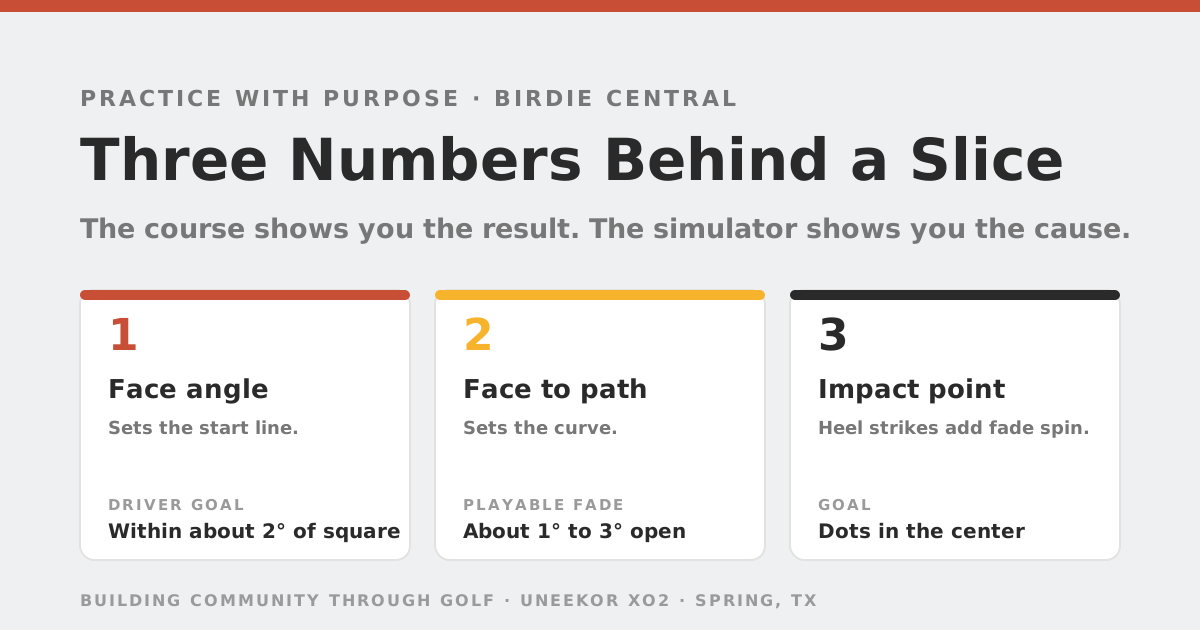
The Uneekor XO2 launch monitors in our bays photograph the club and ball at impact from overhead, so every swing reports face angle, club path, face to path, attack angle and the exact impact point on the face. If you want the full tour of those numbers, our beginner's guide to golf simulator data covers each one. For fixing a slice, you only need three.
The three numbers that diagnose a slice
1. Face angle: where it starts
Look at the face angle on ten drives. Most screens label it with an L or R, or show open as positive and closed as negative; check the label in your software before you draw conclusions. If the face is averaging several degrees open to the target, that explains why the ball starts right of where you aimed. A useful target for a driver is within about two degrees of square.
2. Face to path: how much it curves
This is the slice number. A controlled, playable fade often sits around one to three degrees open to the path. A slice that misses fairways is usually well beyond that, often five degrees or more. You do not need zero. You need a small, repeatable number, and the direction of that number is up to you.
3. Impact point: the hidden slice
Here is the one most golfers never check. With a driver, a strike toward the heel adds fade spin through what club designers call the gear effect, and a strike toward the toe adds draw spin. Some golfers have a perfectly reasonable face and path and still slice, because they catch the ball a half-inch toward the heel every time. If your impact dots cluster heel-side, fixing contact might fix the slice without touching anything else.
Which slice do you have?
Once you have ten swings of data, your slice will usually fall into one of three patterns. Each one has a different fix, which is exactly why generic slice tips work for some people and make things worse for others.
The pull slice
The numbers: path well to the left (out-to-in), face pointing left of the target but less left than the path.
What you see: the ball starts left and bends hard right.
The fix: path. This is the classic over-the-top move, and the goal is to swing more from the inside. The face is fine relative to the target; it only looks open because the path is so far left.
The push slice
The numbers: path near neutral or even slightly in-to-out, face open to both the target and the path.
What you see: the ball starts right and keeps curving right.
The fix: face. Working harder on path will not help here and may make it worse. Grip and clubface control are the levers.
The straight-start slice
The numbers: face close to square at the target, path a few degrees left, contact often toward the heel.
What you see: the ball starts on line and fades too much.
The fix: usually a mix of a slightly better path and centered contact. This is the closest to a playable fade, and often the quickest to tame.
The fix, one variable at a time
The single biggest mistake in slice practice is changing three things at once. The simulator only helps if you can connect a change to a number. Pick the one variable your pattern points to and leave everything else alone for the session.
If your pattern says path
- The headcover gate. Set a headcover just outside and slightly behind the ball, toward your back foot. An over-the-top swing clips it. Make half swings that miss it, then three-quarter swings, then full swings, watching club path move toward neutral.
- Feet together, half speed. A narrow stance makes it much harder to lunge at the ball with the upper body. Hit ten balls at half speed and watch the path number, not the carry.
- Aim the alignment stick right. Lay a stick on the mat pointing a few yards right of target and swing along it. On a sim, you can see within five balls whether the path followed.
If your pattern says face
- Check the grip first. A grip that is too weak, with the hands rotated toward the target, makes squaring the face hard work. Turning both hands slightly away from the target is the most common starting point. Make a small change, hit ten, and compare face angle averages.
- The toe-up drill. Make slow half swings and pause at hip height on the follow-through. The toe of the club should point roughly at the ceiling. If the face is still looking at the screen, it was open through impact.
- Tee it and hold the finish. Hit ten three-quarter drives and hold the finish for a count of three. Rushed releases tend to leave the face open, and a held finish slows everything down just enough.
If your pattern says contact
- Tee height check. A tee that is too low often produces heel and low-face strikes with a driver. Raise it so about half the ball sits above the crown and watch where the impact dots land.
- Stand a touch farther away. Heel strikes often come from the hands drifting out toward the ball. A small setup change is easier than a swing change, and the impact map will tell you in ten balls whether it worked.
Ready to try it on your own swing? Book a bay online, grab a driver and a 7-iron, and give yourself one hour with the plan below.
A 60-minute slice session in the bay
This fits neatly inside one hour of bay time. Keep a note on your phone of the averages at each step; the before and after is the whole point.
- Warm up, 8 minutes. Wedges and short irons, screen ignored.
- Baseline, 10 minutes. Ten drivers at normal effort. Write down the average face angle, club path, face to path and where the impact dots cluster. Decide which of the three slice patterns you are.
- Isolate, 20 minutes. Pick the drills for your pattern only. Start at half speed with a 7-iron, where changes show up clearly and misses are smaller, then move up to the driver.
- Retest, 10 minutes. Ten more drivers at normal effort. Compare the averages to your baseline. A two-degree improvement in face to path is a real result.
- Play it, 12 minutes. Play three or four holes on a course you like. Hit your new swing on real tee shots, with a target, and see how it holds up when there is something at stake.
If you want a broader practice structure for other weeks, our 60-minute golf simulator practice plan builds this kind of focused block into a full routine.
How long does it take to fix a slice?
Longer than one hour, shorter than you fear. Most golfers who repeat the same drills with the same numbers see the face to path shrink within two or three sessions. Making it hold up on the course, under pressure and without a screen telling you the answer, usually takes a few weeks of steady practice.
Frequency beats duration. Two focused hours a week will do more than one marathon Saturday, and that is where around-the-clock access helps. Once you have done the one-time setup, you can book a bay at 6 AM before work or after the kids are in bed. Our piece on how 24/7 access changes the way you practice covers how members fit it in.
And then take it outside. A simulator is where you find out what is happening; the course is where you find out whether it sticks. Hit your new swing on the range, then on the first tee at Gleannloch or wherever you play. Real grass, wind and nerves are part of the test, and the two settings work best together.
Common questions about fixing a slice
Should I just aim left to play my slice?
It is a fine short-term fix for a round this weekend, and plenty of good golfers play a dependable fade. The trouble is that aiming left often steepens an out-to-in path, which makes the slice bigger over time. Use aim as a band-aid on the course and the numbers to fix the cause in practice.
Why do I slice my driver but not my irons?
The driver has the least loft in the bag, and less loft means sidespin shows up more in the flight. It is also the longest club, which makes the path and face harder to control, and heel strikes add slice spin through gear effect. The same face to path that produces a gentle fade with a 7-iron can produce a big slice with the driver.
Is a golf simulator accurate enough to fix a slice?
For this job, yes. The Uneekor XO2 measures face angle, club path and impact point directly with overhead cameras rather than estimating them from ball flight. Our article on how accurate golf simulators are goes deeper on what to trust and what to double-check outdoors.
What does a practice hour cost at Birdie Central?
Open bays start at $25 an hour Monday to Thursday before 4 PM and after 9 PM, and private bays start at $35. Rates are per bay, not per person, so a practice buddy halves the cost. Full rates are on our play and pricing page, and if you practice regularly, memberships start with a $19 Players Pass that takes $5 off every hourly rate.
Straighten it out on Champion Forest
A slice is not a character flaw. It is a face angle, a path and a strike location, and all three can be measured and changed. Come see yours. We are at 19059 Champion Forest Drive in Spring, a couple of minutes from Gleannloch Pines, with six Uneekor XO2 bays, loaner clubs at no charge, canned beer and wine during staffed hours, and a team happy to help you find the numbers on screen. Book a bay, bring your driver, and let's find out which slice you have. Building community through golf, one straighter drive at a time.