
It is one of the most common questions we hear from golfers around Spring and Klein: if I have an hour to get better, should I spend it at the driving range or in a simulator bay? Here is the honest answer up front. Both work, and both belong in a well-rounded golf life. The real difference is not which one is "better," it is what each one tells you, and how quickly you can turn that information into a better swing.
Let's walk through it fairly, because we love the range and the golf course as much as anyone. Then we will get specific about why measurable, structured reps tend to move the needle faster for the average improving golfer.
The case for the driving range
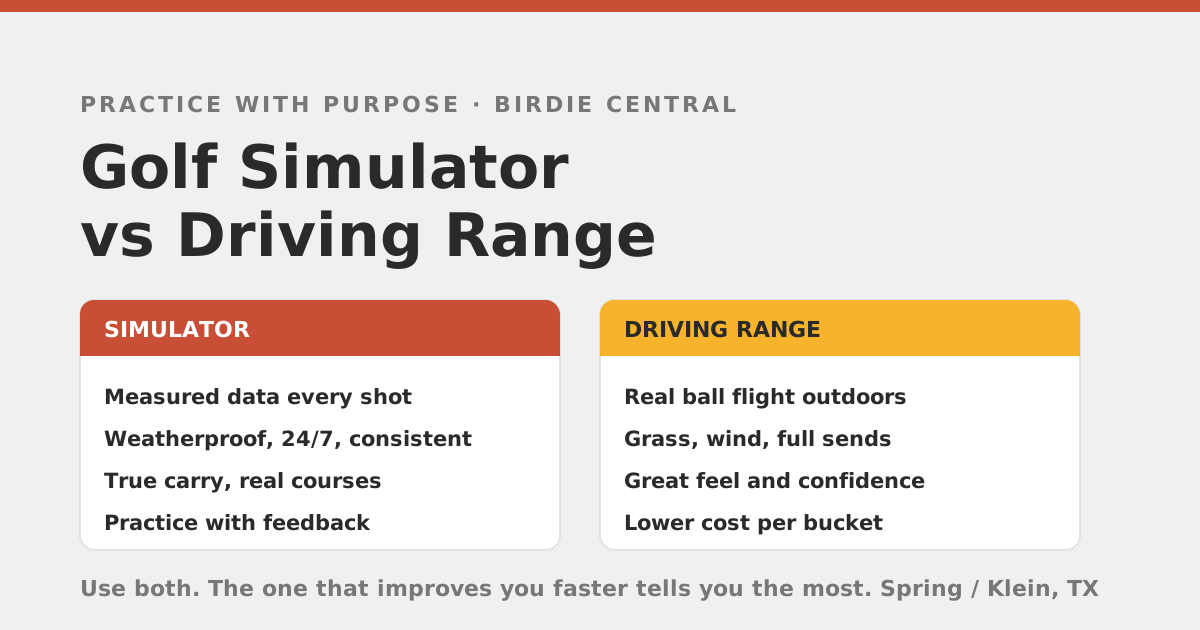
The range has earned its place in the game, and it does several things a simulator simply cannot. You are hitting a real ball, off real grass, into open air, and watching true ball flight against the sky. That feedback loop of eyes on the ball is something golfers have trusted for a century, and it builds a feel for shot shape and trajectory that is hard to replace.
An outdoor range is also the place to feel a full send with the driver, to test how a shot holds up in real wind, and to build the kind of on-course confidence that comes from watching a ball actually fly and land. Many ranges have short game and putting areas too, where you can work uneven lies and the touch shots that decide your score. And a bucket of balls is usually cheaper than an hour of dedicated practice anywhere indoors. None of that changes. The range is a genuinely good use of your time.
The case for the simulator
Where a simulator pulls ahead is information. Every single shot you hit on a quality launch monitor is measured, not estimated. At Birdie Central our bays run Uneekor XO2 overhead systems, so you see ball speed, launch angle, spin, carry distance, and club and ball path on the screen the instant the ball leaves the face. Instead of squinting into the sun and guessing whether that one carried 150 or 165, you know.
The simulator is also weatherproof and consistent, which matters more than it sounds. A Houston summer afternoon or a sudden downpour never cancels your session, and the conditions are identical every time, so you can actually tell whether a change you made is working. You can hit to specific on-screen targets, play full holes on real courses, and log your numbers session to session to watch trends over weeks. That combination of instant feedback and repeatable conditions is what turns "hitting balls" into practice with a purpose.
The real difference: feedback and reps that count
Here is the heart of it. Improvement happens fastest when you can make a change, see exactly what it did, and adjust, over and over. At the range, your feedback is the flight of the ball, which is useful but incomplete. You might sense that a shot felt better without knowing that your spin dropped 800 rpm or your club path shifted three degrees. On a simulator, that information is right there after every swing, so your practice becomes a tight loop instead of a guessing game.
That is why, for the average improving golfer, structured simulator practice often produces faster gains. Not because the range is bad, but because measurable feedback lets you practice the right thing instead of just repeating what you already do. If you want a plain-language tour of what all those numbers mean, we broke it down in understanding your launch monitor numbers, and if you are skeptical that indoor tracking can be trusted, we tackled that head on in how accurate golf simulators really are.
An honest word on range balls and mats
Fairness cuts both ways, so two caveats worth knowing. Range balls are often limited-flight or well-worn, so they can carry shorter and spin differently than the premium ball you play. That means the distances you see at some ranges are not your true numbers, while a simulator reads a normal ball and gives you distances you can actually trust on the course. On the flip side, hitting off a mat can be forgiving of slightly fat contact, so a mat will not always punish a strike the way firm turf does. The takeaway is not that one lies and the other tells the truth. It is that a smart golfer knows what each tool is telling them and practices accordingly.
How to actually improve faster in a sim bay
A simulator only speeds you up if you use it well. Mindlessly pounding drivers indoors is no more productive than doing it outdoors. A few simple habits turn an hour in the bay into real progress:
- Pick a target and a number. Aim at a specific fairway or flag on screen and watch one metric, like carry distance or dispersion. Practice with a purpose, not just a bucket.
- Chase consistency, not the highlight. One 280-yard bomb feels great, but ten shots that all land in the same window is what lowers scores. Use the data to tighten your pattern.
- Mix your clubs and shots. Instead of hitting twenty of the same wedge, rotate clubs and targets the way a real round demands. Varied practice transfers to the course better than grooving one shot.
- Play actual holes. Loading a full course forces you to hit different shots under a little pressure, which is closer to real golf than a straight range session.
- Track it over time. Because the conditions are identical every visit, your numbers from last week are a fair comparison. Watching a trend move is the most motivating feedback there is.
Do that a couple of times a week, all year, in air conditioning, and it adds up quickly. That steady, measured repetition is exactly what our membership options are built for, and if you would rather just drop in by the hour, the bay pricing is straightforward and priced per bay, not per person.
The best answer is usually both
If you make us choose one tool for fast improvement for the typical mid-handicapper, the simulator's measurable feedback and year-round consistency give it the edge. But the smartest golfers we know do not choose. They use the sim to diagnose and rebuild, dialing in real distances and a repeatable pattern with data on every swing, then take that sharper game to the range and the course to let it breathe in real conditions.
Think of the bay as the lab and the course as game day. The reps you bank indoors show up the next time you tee it up at Gleannloch or head out for a weekend round. That is the whole idea behind what we are building in Spring: a modern place to practice with purpose, sharpen your game, and stay ready for golf no matter what the Texas weather is doing.
Frequently asked questions
Is a golf simulator good for actually getting better, or just for fun?
Both. The fun is real, but the improvement is the point for a lot of our golfers. Because every shot is measured, a simulator gives you the kind of instant, specific feedback that helps you practice the right things and see progress over time.
Are the distances on a simulator accurate?
On a quality, calibrated system reading a normal ball, yes, they are dependable. In fact they are often more trustworthy than a range that uses limited-flight or worn balls, since those can carry shorter than the ball you actually play.
Should I stop going to the driving range?
Not at all. The range and the course are great, and we encourage both. The simulator is a complement that speeds up the diagnostic and rebuilding part of improvement, then you take that sharper game outside.
How often should I practice to see a difference?
A couple of focused sessions a week, using targets and tracking a metric or two, will show up faster than occasional marathon sessions. Consistency beats volume, and year-round indoor access makes consistency easy.
Come practice with purpose
The driving range versus the simulator was never really a rivalry. It is two tools with different strengths, and the golfer who understands both improves the fastest. If you want practice where every swing comes with honest feedback and the weather never gets a vote, we built exactly that a short drive from Gleannloch.
Grab a bay, bring whoever you want, and see your real numbers for yourself. Book your session at Birdie Central and start turning practice into progress. Building community through golf, one honest number at a time.