
Here is the moment that hooks people on league night: a 22-handicapper, someone who freely admits they slice half their drives, walks off the sim having beaten a near-scratch golfer straight up. No fluke, no gift. That is the handicap system doing exactly what it was built to do, and it is the reason a golf simulator league is one of the most welcoming ways to compete in the whole sport.
If the word handicap has always felt like insider jargon, this guide is for you. We will walk through what a handicap really is in plain English, how the numbers get calculated, and how indoor golf leagues put their own spin on the system so that every skill level has a real shot at the trophy.
What a golf handicap actually is
A handicap is simply a measure of your potential playing ability, expressed as a number of strokes. The higher the number, the more strokes you typically take relative to par. The whole point is to let players of different abilities compete fairly, so a beginner and a veteran can play the same match and both have a genuine chance to win.
Under the World Handicap System, the version used at courses worldwide, there are two numbers worth knowing.
Handicap Index versus Course Handicap
Your Handicap Index is a portable number that travels with you. It is calculated from the best 8 of your last 20 score differentials, so it reflects your potential on a good day rather than your average day. To establish an initial Index you need to post a minimum of 54 holes, which can be any mix of 9-hole and 18-hole rounds.
Your Course Handicap is that Index translated for the specific course and tees you are about to play, because not every course is equally hard. The formula looks like this:
Course Handicap = (Handicap Index x Slope Rating / 113) + (Course Rating minus Par)
Slope Rating measures how much harder a course plays for a bogey golfer than for a scratch golfer, on a scale that runs from 100 up to 155, with 113 as the neutral baseline. Course Rating is the score a scratch golfer is expected to shoot. Plug in a Handicap Index of 16.4 on a set of tees with a Slope of 127, and you land at a Course Handicap of about 18.
Gross versus net scoring
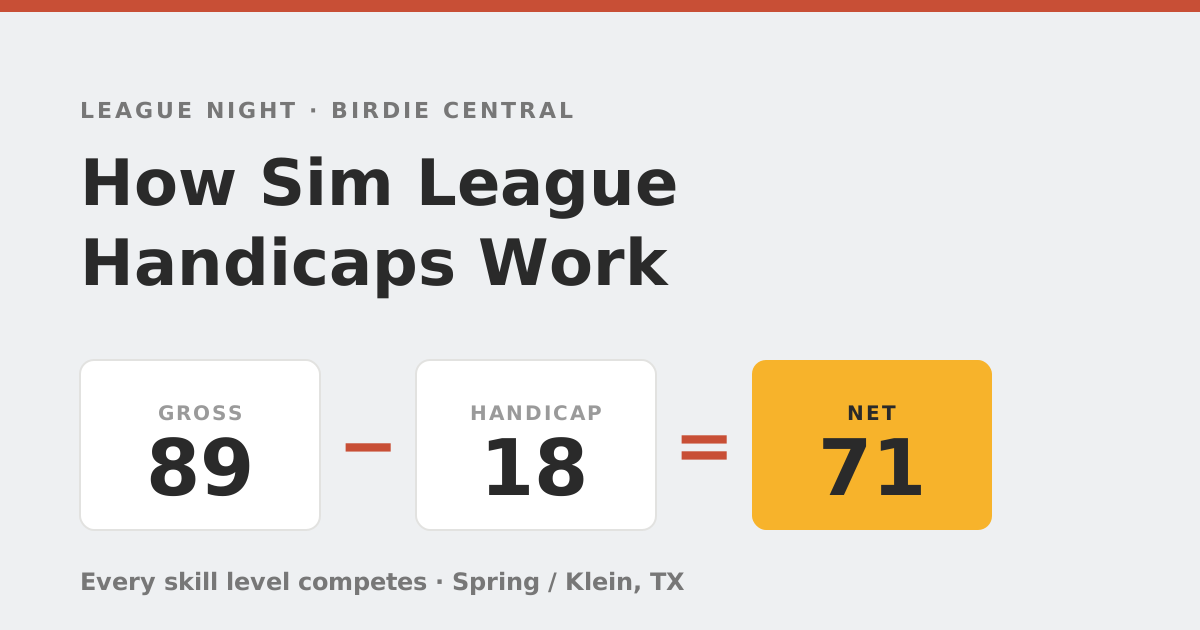
This is where it all pays off. Your gross score is the raw number of strokes you took. Your net score is that gross score minus your Course Handicap. So if you shoot a gross 89 and your Course Handicap is 18, your net score is 71.
Leagues that score net are comparing everyone at the same level. The scratch player who shoots 72 posts a net 72, while our 18-handicapper who shot 89 posts a net 71 and wins the hole. Same course, same night, fair fight.
How simulator leagues put their own spin on it
Indoor golf leagues borrow the logic of the World Handicap System but usually run a simpler, faster, league-specific version. Instead of waiting on a formal Index, most sim leagues build a handicap from the scores you actually post in the league, and they update it as the season goes.
A few things tend to be true across most simulator leagues:
- Handicaps recalculate weekly. Rather than the best 8 of 20, many leagues use a rolling average of your most recent 4 to 6 rounds, so your number tracks your current form closely.
- There is often a slight haircut. Leagues commonly apply about 90 percent of your calculated handicap, which keeps the very high handicappers from running away with things on a hot night and rewards consistency.
- Blow-up holes get capped. A version of Equitable Stroke Control, or a net double bogey cap, limits the damage from one disaster hole so a single quadruple bogey does not wreck your night or distort your handicap.
- Maximum handicaps exist. Many leagues cap the handicap itself, so there is a ceiling on how many strokes anyone receives.
New to the league and have no handicap yet? No problem. Most leagues establish your starting number one of two ways: you play a few casual rounds beforehand and average them, or the league simply uses your scores from the first couple of weeks and sets your handicap from there. The sim makes this painless, because it records every shot automatically. There is no scorecard to fudge and no math to do by hand.
That automatic data capture is the quiet advantage of an indoor league. The same launch monitor that shows you your carry distance is also logging every stroke, which means your handicap is built on clean, honest numbers. If you want to understand what all those readouts mean, our guide to understanding your launch monitor numbers breaks it down, and if you are wondering whether the tracking can be trusted in the first place, we covered exactly that in how accurate golf simulators really are.
Why handicapped scoring makes league night better for everyone
Handicaps are not a participation trophy. They are the mechanism that keeps a season interesting from week one to the finale. When the scoring is net, the standings do not simply reward whoever hits it the furthest. They reward whoever plays best relative to their own game, which means a steady mid-handicapper on a good night can top the leaderboard over a low-handicapper who is fighting their swing.
For newer players, that is everything. You are not showing up to get run off the course. You are showing up with a real chance to win your match, learn from better players in the next bay, and watch your handicap drop as you improve. For the low-handicap crowd, the net format keeps things honest and competitive rather than a foregone conclusion. Everybody has a reason to keep showing up, and that is what turns a schedule of matches into an actual community.
Common league formats you will run into
Handicaps plug into almost any format, and sim leagues love to mix them up over a season that usually runs about 8 to 10 weeks. A few you are likely to see:
- Net stroke play. Lowest net score wins. The simplest and most common way to score an individual league.
- Match play. You go head to head hole by hole, with strokes given based on the difference in handicaps. Great for drama, since every hole is its own little contest.
- Stableford. You earn points per hole against a target, which rewards aggressive play and forgives the occasional blow-up.
- Team formats. Best ball, scramble, and alternate shot pair players up, often blending handicaps so teams are balanced. These are the most social of the bunch.
The beauty of playing on a simulator is that switching formats, or even switching famous courses, takes a few taps. One week your league might play a local-feeling par 72, the next a bucket-list course you would never otherwise get on. The handicap system rides along the whole time, keeping it fair no matter where you tee it up.
What handicapped play looks like at Birdie Central
We built Birdie Central in Spring, right in the Klein and Gleannloch corridor, to be the kind of place where golf and community sit side by side. Our six bays run Uneekor XO2 launch monitors, so every shot you take is measured and logged automatically. That is the exact foundation a fair, honest league handicap needs, with no clipboard required.
Picture a typical league night: about two hours on a weeknight, your match on the sims, standings moving on the screen, and a cold beer or a glass of wine in the lounge while you talk a little trash about next week. Rain, heat, or the early Texas sunset never gets a vote. And because the scoring is handicapped, the newcomer who joined three weeks ago is genuinely in the hunt against the members who have been here since day one.
We love the course too, and a sim league is a perfect complement to your outdoor game rather than a replacement for it. The reps you bank on league night are the reps that show up the next time you play Gleannloch or head out for a weekend round. If you are thinking about making the sim your regular practice home, our membership options and straightforward hourly pricing lay out every way to play, whether you come once a month or three times a week.
Frequently asked questions
Do I need an official handicap to join a simulator league?
No. Most sim leagues, ours included in spirit, build your handicap from the scores you post in the league. If you have never had an official Handicap Index, you simply play a few rounds and the league sets your number from your results.
Can a beginner really compete against better golfers?
Yes, and that is the entire point of net scoring. Because your handicap is subtracted from your gross score, you compete against the course and your own potential rather than against someone else's raw skill. A newer player having a good night can absolutely beat a scratch golfer.
How is my handicap kept fair as I improve?
League handicaps typically recalculate every week or two from your most recent rounds, so as your scores drop, your handicap drops with them. That keeps the competition balanced all season and quietly rewards the work you put in.
Does the simulator track my scores automatically?
It does. The launch monitor records every shot, so scoring is automatic and accurate. That removes the guesswork and the honor-system worry, which is one of the nicest things about competing indoors.
Come find out where you stack up
A handicap is really just an invitation. It says the game has a built-in way to make room for you, exactly as you play today, and to keep making room as you get better. That is what league night is about, and it is what we are building in Spring one match at a time.
Grab a bay, bring whoever you want, and get a feel for the setup. Book your first session at Birdie Central, and when league season fires up, you will already know your way around the bays. Building community through golf, one net birdie at a time.